Saturday, March 10, 2012

Hargeisa (2)

However depressive Hargeisa may look upon entry – and in fact, however depressive Hargeisa may look, full stop -, much is being compensated by the people here. Granted, our immediate comparison is Ethiopia, and you know by now that we have not been wholeheartedly impressed by the Ethiopians in general, but even without this, Somalilanders must rank towards the top in the list of most friendly, genuine people.
We booked ourselves in the Oriental Hotel – not as flashy, perhaps, as its famous Bangkok namesake, but by all means a very comfortable place, with extremely nice and helpful staff. And it is not that they have tourists here every day. It already starts at the door, with an automatic contact that makes an electronic voice say “Salaam Aleikum” every time the door opens, and closes. Every time! A stroll through downtown Hargeisa has scores of people, men and women, coming out to greet us, ask us how we are, where we are from (many know Holland, have family in Holland), and then welcome us into Somaliland. Genuinely welcome us, want us to feel at ease. There is nothing like the opportunistic approaches that we constantly experienced in Ethiopia. Nobody asks for money.
On the contrary, when I find a local bus to go to the camel and goat market, outside town, one of the passengers pays for my fare, and no protestations from my side can change that. By the time we reach the market – 20 minutes later, that is what it took to progress the 2 kms, and not because of the traffic, but because every 50 meters somebody needs to get out or get in, and nobody is really in a hurry – by the time we reach the market, one of the passengers comes with me to make sure I find the place, 200 meters down a side street. The market ground is actually also the football pitch, but used in the mornings for trading camels and goats. Goal posts come in handy. It is not very busy, today, perhaps some 60-80 camels, with the name of their owner written on their hump, and a few hundred goats, in small groups. Sellers cramp under a parasol, awaiting potential buyers. Everything moves very slowly, nothing spectacular, but it is fun to absorb the atmosphere. And fun to talk to everybody who approaches me, once again out of curiosity, never with any opportunistic intention – or it must be that they want their picture taken, too.
In town, there is nothing really. Few of the streets are tarmac, some others are covered with irregular cobbles, most are just dirt roads, and in any case there is sand and dust everywhere. The things to see are the mosque, not very special, and the war monument, a Russian MIG fighter aircraft. Also not very special, really. But it doesn’t stink in town, no pee smell, no human excrements in street corners. No smell of rotting fruit in the humble market (which in any case is dominated by non-food items, shoes and cloths, and mattresses, especially). The relatively few cars and buses nevertheless manage to produce a chaos, not helped by the people pushing wheel barrows – the preferred way of transporting goods, and sometimes the elderly. But the best is the complete traffic jam after lunch, in the street where chat is being sold. Every self-respecting Somali climbs in his four-wheel drive (or 20 year old Toyota station wagon, or just walks) to get to chat-street and get his portion of fresh chat to get through the afternoon. In effect, this country only works half-days, in the morning. In the afternoon the nation resolves to chewing chat, a narcotic providing this pleasant stoned feeling that ensures that you don’t do anything anymore for the rest of the day.
Another feature of this town is the money people. Everywhere, on every corner, you’ll find a few, sometimes up to ten, money changers, with enormous stacks of bank notes in front of them, really, bales of 500 and 1000 shilling notes (8 and 16 $cents, respectively, the largest denomination notes in the country, I think). Some have flimsy metal cages in which they keep the money, many don’t and have the bales just in front of them, on the pavement. Nobody seems concerned about crooks trying to steal any of it. Come to think of it, this is indeed the first day of the trip that I haven’t had the feeling that I needed to watch over my shoulder all the time. The first day that I feel perfectly safe. Nice feeling!

because you are unlikely to ever have been in Hargeisa, and equally unlikely to get their any time soon, I have decided to post more than the usual amount of pictures - how else would you know how it looks like there? And because of internet connectivity limitations, I'll selected the Picassa webalbum route again, so check out https://picasaweb.google.com/bruno.oudmayer/HornOfAfricaHargeisa?authkey=Gv1sRgCPnn7JvwsuCtAQ
for the pictures related to this entry (about 20, or so)

Hargeisa

I mentioned would-be capital Hargeisa already: would-be capital of the Republic of Somaliland. Somaliland in one of the three parts that officially makes up Somalia, the others being Puntland, and the part that gets so often in the news, the southern part of Somalia (let me call this rump-Somalia). Puntland and rump-Somalia are both previous Italian colonies, Puntland is the pirate paradise, somehow semi-autonomous from the rump Somalia, thanks to its healthy and ever growing foreign exchange reserves, and rump-Somalia is now the prototype of a failed state (the past link with Italy is, of course, totally coincidental and the failed state part nothing to do with the colonial past; after all, the other Italian colony in the Horn, Eritrea, is an exemplary country, no?). Somaliland, however, is the former British colony. It was lumped with the rest of Somalia after the Brits left, but then declared its independence from increasingly dysfunctional Somalia in 1991, after a nasty war – every war in this part of the world seems nasty. It has since had several apparently fair and honest elections, has its own government and police force, its own central bank, its own currency, and for all intents and purposes operates as an independent country - except that nobody has yet recognized it. To visit Somaliland, you need a Somaliland visa, which can be issued in Addis Ababa (and perhaps London and Washington, but that seems less reliable).
So one of the first things we did when we arrived in Addis Ababa a month ago was in fact ensuring our Somaliland visa. We managed to find the embassy cum chancellery cum official residence without much difficulty, thanks to good signposting. Inside the compound, the visa section actually operates out of the residency’s garage. The whole process went very smooth, except that the validity of the issued visa turned out to expire before we actually planned to enter the country. When I commented on this, the first response was to use some Tippex – for my younger readers, this is liquid paper used for corrections in the era of typewriters… what are typewriters? Well, ask your parents – Tippex, thus, over the original dates and then write the new dates in, on the Tippex. Right! When I carefully asked if this would not pose problems at the border, the visa assistant first said “I hope not…”, and then, luckily, agreed that it would perhaps be better to issue a new visa – which was issued just as speedily as the first one. And it worked.
And now we are in Hargeisa…

the Somaliland embassy - or rather, liaison office - signposted in Addis Ababa

Friday, March 9, 2012

Wajaale


There are few entries into capital cities – would-be capital cities – more depressing than the entry into Hargeisa. There are few more depressive ways of entering a capital city than the way we entered Hargeisa today.
It all started quite well, with the best scrambled eggs we have had so far (admittedly, combined with the worst coffee), with the tuktuk driver of the previous day waiting for us outside the hotel to take us to the bus station, and with a reasonable size bus almost ready to depart to Wajaale, the border town between Ethiopia and Somaliland, the self-proclaimed independent state that officially still forms part of Somalia, because nobody else recognizes its independence. We got the last seats in the bus – or that is what I thought, and then they managed to fit another 6 or 8 people in, too. Jam-packed, interestingly almost only with women – I suppose they make the better smugglers, why else would anybody go to Wajaale? – we finally left Jijiga half an hour later. Fill a bus with men, and nobody talks. Fill a bus with women, and you have constant chatter, all the way from Jijiga to Wajaale. Good fun, though, never mind that we were all squeezed on top of each other.
The country side became more and more desolate, the only thing left outside was sand, some yellow grass, low shrubs and the occasional acacia tree. And, of course, more of the round Somali huts, as far as I could see semi-permanently arranged in communities of 10-20 huts, surrounded by cactuses and thin aloe trees, the type that has very small branches and even smaller leaves – and thus provides no shadow, whatsoever. I think this is the most impressive realization, driving through this land. There is simply no shadow, yet, there is a lot of sun, and it is getting pretty hot here, already early in the morning. Hardship, and wretched poverty, despite the still large herds of cattle and goats roaming, despite the groups of camels, 100s of them, trying to find something to eat in between the sharp thorns of the low shrubs.

(1, 2) hamlet of round nomad huts, and one in close-up

(3) barren country side, with roaming herds of camels struggling to find anything to eat

(4) poverty comes to the road, too, and not the rubbish in the trees- there is rubbish everywhere (I know I have complained this before, in many other countries, but I don't think I have ever seen it so bad as here, in Eastern Ethiopia and in Somaliland)

Just before Wajaale we encountered a road block, a rope across the street, no more. No uniforms, nothing to indicate that this was official, yet everybody got out, and a guy in a Barcelona football shirt searched the bus. Passports were checked, and everybody got back in – except that we now no longer fitted, so even more people were standing next to the door, which didn’t close anymore. With open door we drove into Wajaale, disembarked from the bus, chased the porters away – lots of them ready, with wheel barrows, very efficient on the dirt road – and made our way to customs. I seldom had a smoother border passage. The shed on the Ethiopian side looked distinctly unpromising, yet inside there were computers, passport scanners, cameras and fingerprint machines, friendly customs officers who immediately distributed evaluation forms on how we thought they were doing, then switched on the AC to ensure the evaluation would turn out positive, in short, excellent. In Somaliland same story, except for the forms and the scanners, and five minutes later we were in the self-proclaimed independent state.
(5) the border - note the rope across the road; a colourless town, dusty, typical frontier town

(6) and the ibusses, scavengers who have a field day in the rubbish accumulated on both sides of the border, and in the no-mans land in between

(7) still, even in grey, dusty and rubbish infested Wajaale there are colourful moments to be recorded

Next, we needed to find transport to Hargeisa, some 90 km further on. No busses, here, no minivans either. Shared taxis, in the form of 20 year old Toyota station-wagons, that is the only thing available. Two people in the passenger seat, four in the back seats, and at least two, plus any children, all the way to the back, in the luggage compartment – luggage itself goes on the top, needless to say. I don’t think we ever had a more uncomfortable way of transport than this one, and that for 2.5 hours. First, with the car finally full – despite the fact that we were obviously the last passengers, this still took about an hour more -, stop at the fuel station, and fill up, thanks to my contribution to the journey. Then, stop to put some air in the tires, clearly some routine necessary before every trip. After all of this, 500 meters on, first road block, another rope.

(8) a shared taxi, half full - this is a truly uncomfortable way of transport, believe me!

The windows of our Toyota were opened and closed using a wrench; a screw driver in the ignition contact was used to start the engine – and switch off again -, a process that was frequently repeated because of the five more road blocks we encountered on the way to Hargeisa. At each of those we needed to show our passports again, and the later it got, the more time-consuming this process became: each time police officers, increasingly stoned from chewing chat, had more difficulty finding our visa in our passports, and once I even had to explain why we hadn’t received an exit stamp yet (really).
The first half hour we drove through the fields: the road was obviously too bad to use, and next to the road a network of tracks had developed, smoother than the road itself – although smooth is relative the way we were packed into the taxi. Then we hit the tarmac, and things got slightly better. Our driver was good in avoiding the pot holes if he was not on the mobile phone; he was on the mobile phone a lot.
(9, 10) a network of tracks has developed beside the road; the tracks are not only used by cars, of course...

Outside, the country side hadn’t changed. Still bone dry, still livestock and small round huts – I don’t think we saw any normal building, defined as four mud walls and a corrugated iron roof, for at least two hours, outside the occasional small village. Flat landscape, save the occasional hill, without any vegetation. And then the rubbish along the road! In fact this was something that had been appearing in increasingly worrying amounts since Harar; plastic bags, bottles, scraps of paper, everywhere on the ground, and thanks to the wind also in all the scrubs and every tree, however rare.

The only things changing with the approach of Hargeisa was even more rubbish, and appearance of the occasional wall in the fields, without any obvious reason. In the distance were some houses, mostly of the mud and corrugated iron type, still in the middle of nowhere, desert surroundings, really, and that turned out to be Hargeisa. Before we realized it, we were in the town centre, if that is the appropriate terminology for a couple of two story buildings. And even more dust than in Jijiga. A town cannot possibly give you a more depressive impression than this. And all that seen from in between the squeezed bodies of our fellow passengers in a Toyota shared taxi.
(11) the outskirts of Hargeisa (any other picture would be too depressive to close this entry with)

Thursday, March 8, 2012

Jijiga (2)


One of the pleasant surprises of our trip to Jijiga was that the gravel road, mentioned in our various guide books, has been upgraded to brand new tarmac, which cuts the travel time in half. I had installed myself in the front seat, next to the driver, because the trip – according to those same guide books – promised to go through spectacular country side: the Valley of Marvels, no less, and the “well-wooded Karamara Mountains”. Right! I did see some typical weathered granite rocks on the way, presumably the valley, but I completely missed any well-wooded mountains. Lots of charcoal for sale, though. In reality, the country side here is getting ever dryer, and less and less inhabited. The typical rounded Somali huts of nomads are appearing, along the road, and further afield; these are small huts, made of wood and mud, it seems, and reinforced with the occasional corrugated iron sheets as walls and a collection of rags, and sometimes tarpaulin, stretched over the roof. If we have seen any poverty on the way, this beats all of it – and yet, there are also herds of cattle, and especially large flocks of sheep and goat, presumably representing some form of wealth. Perhaps the huts are just convenient, easily packed up and placed somewhere else, for a change of pasture – if it may have that name, the ground is really dry, and whatever grass grows, looks burned yellow. But these people have little else, that is for sure, no government-supplied amenities, schools, hospitals, and almost certainly no fall-back position if their livestock dies, not an unthinkable prospect in these circumstances.

(1, 2) this must be the Valley of Marvels, rather underwhelming, with its "precariously balancing rocks"


(3, 4, 5) Somali nomad huts, together in small hamlets, or isolated, protected by a rim of cactuses; people are living here, in these huts, and working, like the lady carrying fodder for the animals

But back to Jijiga. The town “boasts an unexpectedly cosmopolitan feel, which is reflected in the high standard of hotels, restaurants and other facilities”. Right! Not sure how long this guide book author had been traveling when he wrote this, but Jijiga is most certainly not cosmopolitan! The top hotel in town, the one with good western food, only had – guess what – spaghetti with tomato sauce, which was served in the lobby, because the restaurant was closed – and from the looks had been for some time. So had been the hot water supply, and the toilet flushing system. We found one other restaurant that looked OK, and which distinguished itself with using newspaper pages for place-mats. We found no other facilities. Well, yeah, there is a market, of course, and probably quite some “special supplies” on account of its proximity to the border, but nothing to get too excited about. Dust is what we remember most, about Jijiga, dust.


(6) Jijija centre, this is the main street, a bit of a wild-west town, don't you think? If the goats running through the centre would have been horses, you could just imagine the bank on the right, the gun smith of the left, and next to that, the saloon - except that Jijiga is predominantly Muslim, not many saloons here (well, we found one, but no wine, and no tonic)


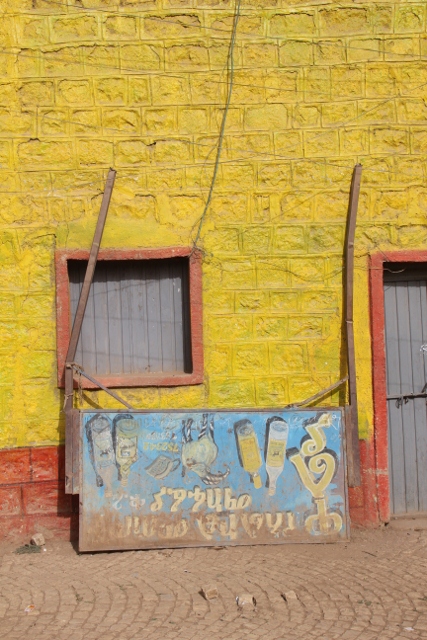
(7, 8, 9) but you can find more colourful plces in town, the hole-in-the-container-wall-shop, a - get this! - ancient liquor store, of which the sign board anouncing dry gin has fallen down, and veterinary phramacy, clearly for local animals (the drawings are remarkelby accurate, compare the donkey with the real one!)

 
 (10) woman trying to sell me chat, and (11) market seller contemplating
(12) and this lady was finally convinced to have her picture taken, too, and did she love it!
(13) never to get enough of, colourful ladies in the market, against an equally colourful background: easy concept, makes great pictures every time again.

the Adel tribe

Somewhere in his book Young Nega describes entertainingly the dangers of encountering men from the Adel tribe, a tribe inhabiting the area west of Jijiga – which had to be crossed during the exodus from the town, ahead of the invading Somali army. (The Adel are Afar people, who inhabited the Adel Sultanate, in the southern extremities of the Afar region.)
The Adelmen had to prove their man-hood for the tribe, and for their future wife, by beating an enemy from another tribe in an open contest. To prove they had done this, they were required to cut off the penis from the defeated, and triumphantly carry it home. But with fewer and fewer tribal wars, life became increasingly difficult for the men, they will have to go further and further from home. In the 1970s they started to attack lonely travelers, or bus passengers that stray off the bus too far during a pee stop – the last time they will pee, for sure! Truck drivers, farm workers, nobody was safe, especially during the traditional Adel wedding months. Size matters:  a boy’s penis would not do, and if there could be any doubt, the conqueror had to cut off the entire pelvis, to prove it had been a man. For obvious reasons Adelmen were not welcome on public transport anymore, so were forced to cross the desert on foot, a time consuming business – and risking that by the time they finally got home they would be accused of having robbed a grave, instead of a man, judging by the state of the trophy!
(No pictures to illustrate this story, unfortunately…)

Tuesday, March 6, 2012

Jijiga

We are getting further and further east. Jijiga is the capital of the ethnic-Somali Ogaden region in Eastern Ethiopia. The town features prominently in a book written by Nega Mezlekia, who was born here, and spent his childhood here. Nega was born in 1958, same as me, and in many ways his childhood was not too different from mine: a middle-class family, relatively protected, a schoolboy being naughty, pulling off all sorts of pranks, frequently being expelled from the class room: I recognize that. Yet, there are obviously a lot of things I don’t recognize, my teacher didn’t beat me senseless, I wasn’t subjected to witchcraft to drive out the devil, but mostly, I didn’t live in an Ethiopia.
In the early and mid seventies, I was in my confident, bragging teens, chasing girls and growing up carefree, for all intents and purposes. Ethiopia saw violent regime change, the emperor Haile Selassie was overthrown and subsequently killed, and a military junta, the Derg, took over. As so often, internal conflict weakened the junta, opening up opportunities for separatist movements, amongst them the Western Somali Liberation Front inside Ethiopia. Any Liberation Front worth its salt is supported by another, preferably bordering nation, in this case, surprise, surprise, Somalia, who then saw its chance and invaded Ethiopia. In true Cold War fashion Somalia had initially been supported by the Soviets, who helped them built up their military strength, but when the Ethiopian emperor fell - traditionally supported by the US -, the Soviets decided to link up with the Ethiopians, who thus closed the door to the Americans – are you still following? Not wanting to support two sides of the same war, the Soviets then withdrew from Somalia, whereupon the Americans decided to support the Somalis against the Ethiopians, who were by now helped by 8000 Soviet advisers as well as 15,000 Cuban troops.
Nega was in Jijiga during the war, he must have been 18 or 19. Initially Ethiopian government troops firmly defended the town, in part through rounding up all ethnic Somalis they could find and slaughtering them, executing then  – effectively genocide, of course, although it is not called that in the book. Afterwards the Somali army was winning, forcing an exodus of over 20,000 people from Jijiga first across the strategically important Marda Pass, and then on to nearby Harar. Despite the distance of less than 100 km the trip nevertheless took some two weeks, and came complete with snipers, land mines, mortar attacks, black market traders – who, for good measure, were also executed - and famine. I didn’t have any of that in my youth.
To cut a long story short, the 1977 Somali invasion was ultimately rebuffed by the Ethiopian army, and the Somalis withdrew to their own territory again in March 1978, end of the Ogaden war. Also beginning of the weakening of the Somali regime, of course, of which we see the fall-out today.
It took us a little over an hour to get from Harar to Jijiga.

Harar


The first Westerner to lay eyes on Harar was Richard Burton, he of Burton & Speke fame (from a later expedition to the heart of Africa to explore the source of the Nile). On early travels, in 1854, Burton reached Harar - which he compared to ‘ill-famed Timbuctoo’ as being equally ‘bigoted and barbarous’ (from hearsay, no doubt, as I don’t think he ever went to Timbuktu). He stayed for ten days, as guest, others say hostage, of the local sultan, before being allowed to leave again.
Paul Theroux also went to Harar, some 10 years ago. He describes the town in similar terms as Burton did, commenting on the narrow streets where two pedestrians can hardly pass each other, and on the open sewerage and the heaps of rubbish everywhere.
Theroux also witnessed the feeding of the hyenas, by what is called the ‘hyena man’, somebody who collects scraps of meat and bones during the day to feed to the hyenas at night, forcing the animals to take it from their hands, even from their mouth.  A rather disturbing way of feeding, I would say, but undoubtedly true (I also read about this elsewhere, perhaps in Nega’s book).
 I decided to have a look for myself one evening, and set out to the spot, outside town, where the feeding takes place, but unfortunately, too many able young men decided, at precisely the same moment, to go and have a look as well. The further away from the town centre I got, and the darker it became – feeding hyenas is an after-dark activity –, the more I had the feeling that I was surrounded by human hyenas. Not to tempt faith once more – having money stolen from me, well, I still can continue traveling, just lower the budget somewhat, but having my camera stolen, that would be a trip-ending experience – I turned around and went back to the hotel. You know, this type of experiences doesn’t do much for the general appreciation of Ethiopia.
But in daylight, Harar is a delight. A walled city with five gates – some more impressive than others, and some parts of the wall decidedly less impressive – inside is a labyrinth of narrow alleys and streets (as Theroux observed correctly), curving and climbing, up- and down-hill.  There are no less than 84 small mosques inside, in green and white, or blue and white. Many of the houses have been painted in similarly bright colours as we saw in Dire Dawa, pink, or orange. But even more colourful are the people, many of Somali ethnic origin, I think, with long dresses and wrapped in cloths. And did I mention market before? There are no less than three, here, one at the eastern gate, apparently for the Oromo people, one Christian market just outside the walled city (and right below our hotel room), and one in the city centre, the Muslim market. The latter is the only one with a proper market building, in which the butchers have their shops: outside, the kites have congregated to pick up any scrap of meat that falls, or indeed any piece of meat that is not well covered when taken from the shop. Frightening, really, and they do swoop low across any hapless tourist walking here, as well. (I remember kites from 25 years ago in Tanzania, where they circled above the lunch places in safari parks, and were not beyond diving down to try to grab the sandwiches from the hands of safari goers, with occasionally very painful results.)
(1) one of the original gates of the city, with the chaos of a market in front of it


(2) one of the many narrow alleys in Harar, and (3) one of the 84 mosques
 
(4) two women walking the street


(5) the so-called Muslim market, with the butcher stalls along the covered gallery, (6) the kites in strategic position, in case any meat falls (or is poorly covered), and (7) another side of the market, taken over by Coca Cola advertisements


(8) one of the few two-storey buildings in Harar, along the main road, and (9) a window of one of the older buildings

(10) woman tending a wood-carrying donkey at the so-called Oromo market

We have this eternal debate whether to employ a guide or not. Generally we don’t, because we like to wander around without pressure to move on to the next site, and we reckon that the little additional information the guide provides does not weight up against the amount of superfluous nonsense that we also have to listen to. In Harar we found the solution; we employed Abdullah, no, Abdullah somehow attached himself to us, and we didn’t mind. He was deaf and dumb – which solved the superfluous information part -, but showed us every corner of town, pointing out good photos, interesting views, funny scenes. We managed to communicate, somehow, and saw everything we had on our list, plus a whole lot more. The most interesting part of the experience was that Abdullah knew everybody, and was obviously well respected despite his handicap. In every way he operated as a professional tour guide. And we had fun, for sure!
I didn’t see anything of the bigotry, anything barbarous, during daytime Harar. On the contrary, the Muslim dominance seems to make this a much more friendly place than many other obvious tourist sites in Ethiopia. But at night? I am not so sure.

(11, 12) just outside Harar is an enormous Muslim cemetry, with many of the grave stones carefully painted; a very peaceful place, somehow